

Nainital at the Crossroads: Development or a Slow-Moving Disaster?

Nainital: A Hill Town Being Beautified into Collapse
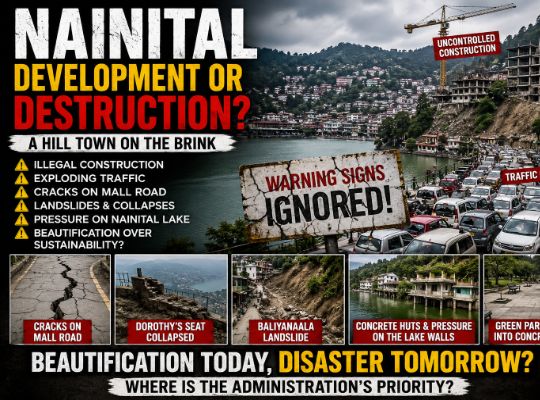
Nainital is often projected as a postcard destination, a jewel of the Himalayas attracting millions of tourists every year. Yet behind the façade of beautification drives, decorative projects and tourism campaigns lies a far more disturbing reality: a fragile mountain ecosystem struggling under the weight of unchecked construction, exploding traffic and administrative complacency.
The uncomfortable truth is that Nainital today appears to be heading not towards sustainable development, but towards an environmental and geological crisis of its own making.
For years, warnings have been issued about the ecological vulnerability of the town. Scientists, geologists, environmental activists and concerned citizens have repeatedly cautioned that the Himalayan terrain has limits. But those limits seem to have become irrelevant in the race for expansion, commercial interests and cosmetic development.
Illegal and questionable constructions continue to rise in and around sensitive zones. Buildings keep appearing on slopes that should have remained untouched. Regulations are diluted, violations are regularised and accountability remains elusive. The obvious question is: who is allowing this to happen, and at what cost?
The irony is striking. Nainital houses the Uttarakhand High Court, an institution that has time and again intervened to protect the environment and preserve the ecological character of the state. Yet despite judicial oversight, environmental norms appear increasingly negotiable when confronted with political priorities, economic pressures and administrative convenience.
Traffic has become perhaps the most visible symbol of this failure.
Lakhs of vehicles now pour into the district every year, many entering a town that was never designed to accommodate such numbers. Roads built for a small colonial-era hill settlement now bear the burden of modern-day mass tourism. Congestion has become routine, pollution is rising and the constant movement of vehicles places additional stress on an already fragile landscape.
The warning signs are no longer theoretical.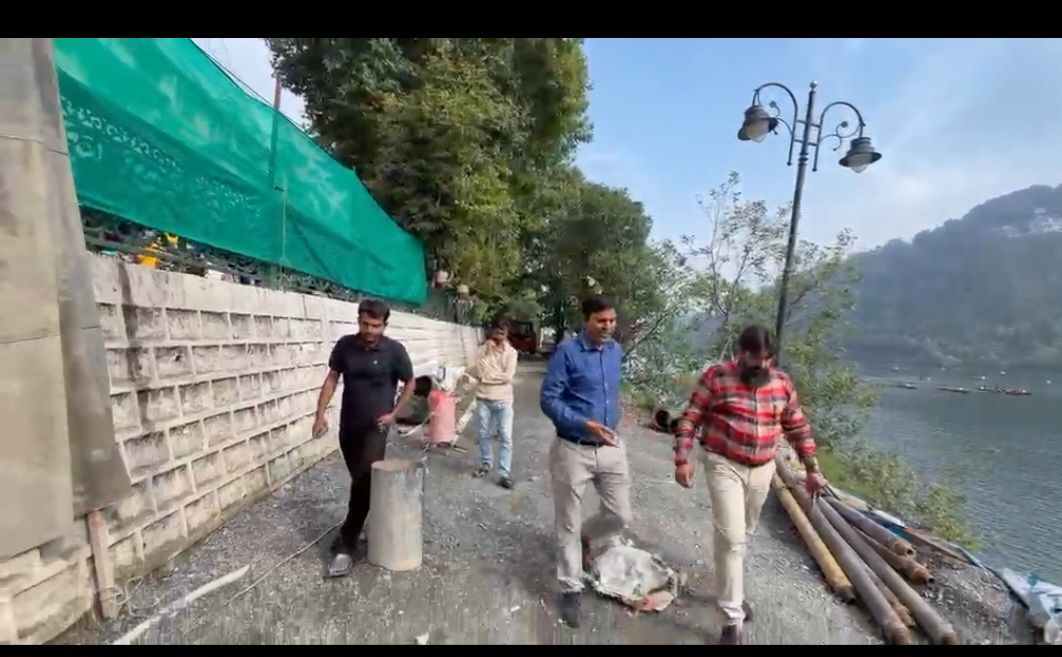
Cracks reported along portions of the historic Mall Road should have prompted serious scientific investigations and urgent policy interventions. Concerns over fissures in the China Peak region deserve immediate attention. The partial collapse around Dorothy's Seat at Tiffin Top was not merely an isolated incident but a stark reminder that mountain ecosystems respond to cumulative pressure.
Baliyanaala continues to slide, year after year, despite decades of studies highlighting its instability. It remains one of the clearest examples of a landscape under distress. Yet the response often appears reactive rather than preventive.
Equally alarming is the increasing concretisation around Nainital Lake. The construction of concrete huts, tourism infrastructure and various permanent structures around the lake basin raises legitimate concerns regarding additional pressure on retaining walls and the overall stability of the ecosystem.
The lake is not simply a tourist attraction or a scenic backdrop for photographs. It is the heart of Nainital. It is the source of its identity, ecology and existence. Any intervention that compromises the integrity of the lake ecosystem should be viewed as a matter of public concern.
Even public parks are no longer being preserved primarily as green lungs. Instead, many are being transformed into heavily engineered spaces dominated by concrete, paving and ornamental installations. Trees, soil permeability and natural landscapes are slowly being replaced by structures marketed under the banner of beautification.
But a mountain town cannot be saved by beautification alone.
Decorative lighting cannot stabilise slopes.
Fresh paint cannot stop landslides.
Landscaping projects cannot compensate for ecological degradation.
Concrete cannot substitute forests.
The larger question is whether governance in Nainital has become increasingly focused on appearances while fundamental environmental challenges remain inadequately addressed.
Are authorities preparing the town for the next fifty years, or merely preparing it for the next tourist season?
How many more cracks must appear before carrying capacity becomes a serious policy discussion?
How many more landslides are needed before construction norms are enforced without fear or favour?
How many more warnings from geologists and environmental experts will be ignored before irreversible damage occurs?
Nainital does not require more cosmetic interventions. It requires courage in governance.
It requires an honest assessment of how many vehicles the town can realistically sustain.
It requires a transparent audit of illegal constructions.
It requires strict enforcement of environmental regulations.
It requires independent geological studies of vulnerable zones.
It requires investment in sustainable mobility systems, peripheral parking facilities and efficient public transport.
Above all, it requires administrators and policymakers to acknowledge a simple reality: mountain ecosystems do not negotiate with politics, publicity campaigns or ribbon-cutting ceremonies.
Nature ultimately imposes its own limits.
Nainital still has time to change course, but the window for meaningful intervention is narrowing. If scientific warnings continue to be overshadowed by short-term optics and beautification agendas, future generations may inherit a town whose beauty survives only in photographs and memories.
The real measure of governance is not how attractive a hill station appears in promotional campaigns, but whether it remains safe, habitable and ecologically resilient for the people who call it home.
Nainital deserves thoughtful planning, not ornamental distractions.
Because when a fragile mountain town begins to crack, the danger lies not merely in the earth beneath our feet, but in the collective refusal to acknowledge what those cracks are trying to tell us.